

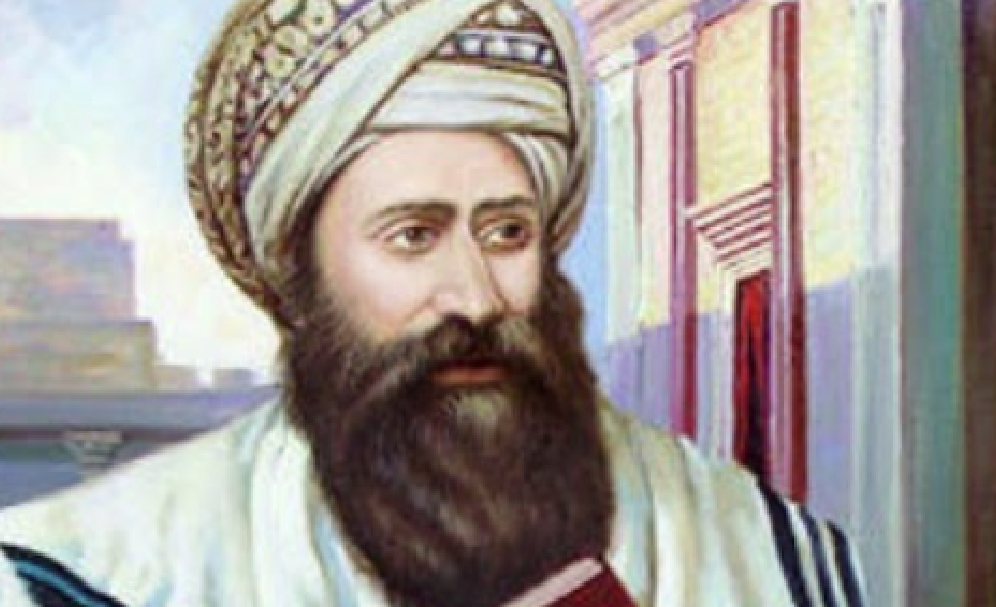
Rabbi Menachem Mendel of Vitebsk
Date of Passing: 1-Iyar. Born in Vitebsk, Russia and died in Teveria, Yisrael. As a 9 year old, young Menachem Mendel was introduced to the Baal Shem Tov...


Rabbi Menachem Mendel of Vitebsk
(Vitebsk, Russia, 1730 – Teveria, Eretz Yisrael 1788) As a 9 year old, young Menachem Mendel was introduced to the Baal Shem Tov by his father, a close follower of the illustrious leader. He was an exceptionally gifted child, destined for greatness. He studied under the Maggid of Mezritch, and was recognized as one of his outstanding disciples.
After the Maggid's death he returned to Vitebsk, settling in nearby Horodok. Among the thousands of chasidism who thronged to him were many prominent former students of the Maggid, such as Rabbi Shneur Zalman of Liadi, Rabbi Baruch of Kossov, and many others.
Horodok became the nucleus from which chasidic influence expanded into the regions of Lithuania and White Russia. At that time, Lithuanian Jewry stood under the spiritual leadership of The Vilna Gaon, a saintly personage now universally revered as the greatest Torah scholar of the past two centuries, who was a staunch opponent of Chasidism. As a result, the Jews of Lithuania, many of whom were mitnagdim – opponents of Chasidism – did not look kindly on the new movement springing up in their midst. They felt threatened by the perceived intruders and resisted chasidic expansion with all their might. In 1777, Rabbi Menachem Mendel, accompanied by Rabbi Shneur Zalman of Liadi, traveled to Vilna with the aim of explaining to the Vilna Gaon the principals of Chassidut and of allaying his misgivings concerning the soundness of its doctrines. The Vilna Gaon refused to receive the visitors. Thereupon Rabbi Menachem Mendel made a historic decision. In order to avoid further altercations he decided to leave the Lithuanian battelfield, and in Adar (March) of 1777 he departed for Eretz Yisrael at the head of a group of about 300 chasidim. It was an unprecedented move. They settled in Tzefat, and later established themselves in Teveria (Tiberias), in the Upper Galilee. This group laid the foundation for future chasidic settlement in Eretz Yisrael, making a significant contribution to the eventual revival of the Galilee as a whole.
From his residence in Eretz Yisrael, Rabbi Menachem Mendel maintained a close contact with his chasidim in Russia through personal emissaries and a steady flow of letters. He was succeeded by his only son, Rabbi Moshe.
His reflections, letters, and commentaries have been published in Pri Ha'aretz. His Torah comments, most of which are quite esoteric and abstruse, are based on Kabbalah and are written in a very compact and terse style, hinting at ideas without elaborating on them. Because he had the distinction of being the first to lead a group of chasidim to settle in Eretz Yisrael, he was-along with other early chasidic rebbes and nonchasidic rabbis of that era – a pioneer in the movement to return to Zion.
The Smell of Mashiach
In his later years, when Rabbi Menachem Mendel of Vitebsk lived in Tzefat. One day he heard a commotion in the street and sent his valet to inquire of its nature. The servant came back with the report that Mashiach had arrived. R' Menachem Mendel opened the window took a sniff, shook his head to the negative and went back to what he was doing.
The question is asked: What does Mashiach smell like and if R' Mendel knew what Mashiach smelled like, why did he need to open the window?
Menachem Mendel of Vitebsk achieved the spiritual level of awareness akin to the Godliness Mashiach will reveal. He knew what Mashiach smelled liked because his room was in a messianic state. He needed to open the window because the outside was not.
May the merit of the tzaddik Rabbi Menachem Mendel of Vitebsk protect us all, Amen.
Source: Daily Zohar









Tell us what you think!
Thank you for your comment!
It will be published after approval by the Editor.