
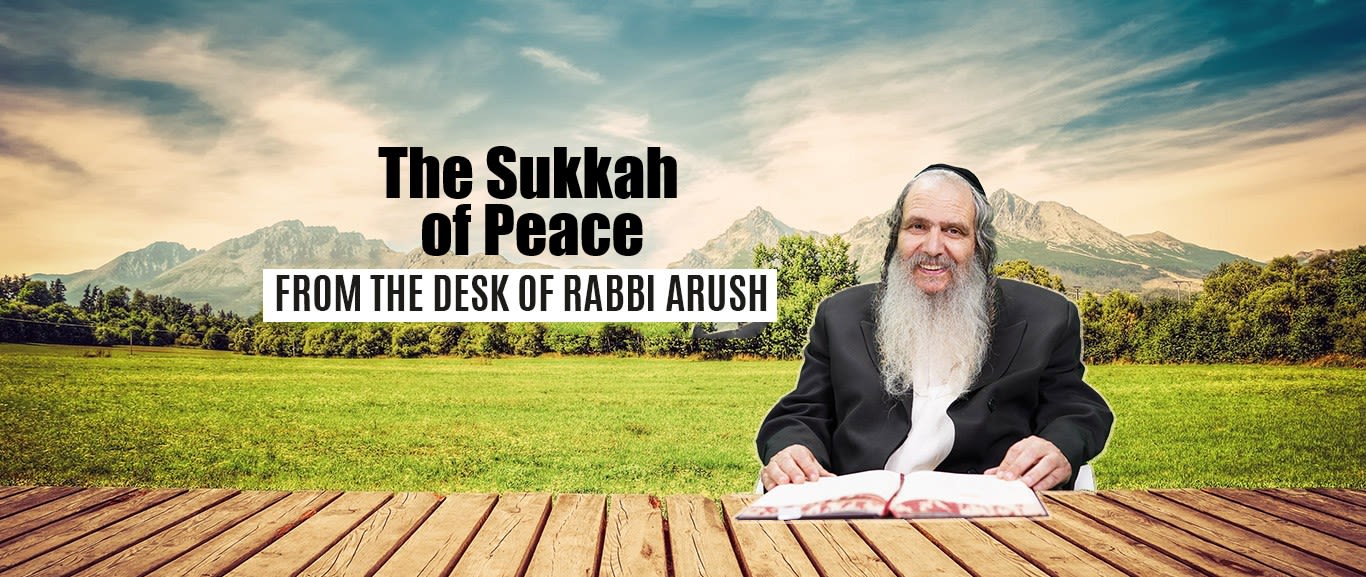
The Sukkah of Peace
Unlock the hidden vessel that secures all of your material and spiritual blessings. Rabbi Arush reveals how Sukkot offers us a clean slate to dissolve conflict, crush a bloated ego, and welcome radical joy into our lives.

Translated from Rabbi Arush’s feature article in the weekly Chut shel Chessed newsletter. The articles focus on his main message: “Loving others as yourself” and emuna.
Peace from All Sides
This year, the Yom Tov of Sukkot will coincide with Shabbat, and that means that Heaven is offering us an extraordinary measure of peace. The concept of sukkah is synonymous with peace, as the passuk states (Tehillim 31:21), “Protect them from strife in a sukkah” – a sukkah protects us from arguments. For this reason, we say in Maariv every night, “Spread Your sukkah of peace over us.”
Likewise, the concept of Shabbat is peace. For this reason, the traditional greeting on Shabbat is Shabbat shalom. We emphasize this in Friday night’s Maariv, asking for Hashem’s sukkah of mercy, life, and peace. This is based on a teaching of the holy Zohar, which adds that the “sukkah of peace” includes all the different levels of kedushah. Chazal taught that the Blessed Holy One’s blessings cannot be held in any “container” other than peace, and this includes both material blessings and spiritual blessings.1
In fact, the entire Torah is described as an instrument of peace, as the pasuk says, “all its pathways are peace”.2 Moreover, Shalom is one of the Blessed Holy One’s Names. Chazal taught that peace is a supreme value. Nothing is greater than peace.
After Teshuvah Comes Peace
For this reason, what we need most of all during these days of teshuvah is peace. Hashem is about to begin recording our sins on a new slate, as Chazal interpreted the pasuk, “Take for yourselves on the first day.”3 This being the case, we really need to increase our efforts for peace. Hashem gave us the mitzvah of sukkah, which symbolizes peace, and He gave us the mitzvah of lulav, which likewise symbolizes the unification of all sectors of the Jewish people. Moreover, the mitzvah of hak’hel, which calls for all Jews to gather together in one giant demonstration of unity, is to be fulfilled once every seven years – on Sukkot.
The Keli Yakar cites the Gemara stating that during Aseret Yemei Teshuvah (ten Days of Repentance) Hashem readily accepts the teshuvah of an individual, but during the rest of the year, He accepts only teshuvah of a united community.4 The Keli Yakar explains that a “united community” means one in which everyone is at peace with each other and feels love toward one another. If there is no peace, it is very difficult to be successful doing teshuvah. When someone does teshuvah by himself, but he does so because he feels connected to the Jewish nation and he does it for the sake of the entire nation, his teshuvah is considered a “community teshuvah” and it is accepted as such.
When we begin Sukkot, and we begin the new slate of recorded sins, we have to begin with peace. The Keli Yakar asserts that every time people argue, it is because each person assumes that he deserves to have everything for himself.5 Therefore, after we go through a year of shemittah, when everyone relinquishes all claims to his fields and orchards, everyone enforces his understanding that everything belongs to Hashem. That is the ideal time to build our inner trait to desire peace. On Sukkot, we all leave our homes, acknowledging that even our homes do not really belong to us. This enables us to embrace the quality of peace.
Peace Protects and Provides Safety
In this way, we find maximum protection. Our enemies chose to attack us in a ferocious manner three years ago while we were celebrating Sukkot. They saw an opportunity because we were in disunity, and we even harbored hatred for one another.
When our trait of peace-seeking is weakest, our physical and spiritual enemies are enabled to inflict harm on us. Chazal taught that so long as there is peace among us, we will win all our battles even if we are guilty of the terrible sin of idolatry.6
When we look around us and see all the rampant strife and hatred affecting our people, the best thing we can do is to be personally at peace with everyone in the world. Chazal defined a true Torah scholar as someone who increases peace in the world. If you are connected to Torah learning, you are helping to bring peace to the world. If you are not bringing peace to the world, that is proof that you have no connection to the Torah.
For this reason, we celebrate Simchas Torah immediately following Sukkot. We want to demonstrate that we are not studying Torah simply to increase our knowledge, but because we are trying to connect ourselves to the ways of the Torah, the ways of peace. We want to be connected to the One Who gave us the Torah, the One Whose Name is Shalom.
To have peace, the most important thing is to be careful of how we speak, and never to say anything negative about the nation of Yisrael. We must never say that people are evil, or belittle them, or speak hatefully about them. For this reason, the Poskim warn us to be especially careful not to speak lashon hara or to argue or speak with anger while in the sukkah.
The Mashiach – Prince of Peace
Sukkot is called zeman simchateinu – the season of our joy. True joy is possible when the trait of peace is cultivated. Rebbe Noson taught in his Likutei Halachot that complete joy comes when someone is at peace with all others and feels genuine love for them.7
The Geulah depends on peace. The Zohar teaches that if a single community achieves peace and mutual love, they have the power to bring the Geulah to our nation. The Geulah depends on teshuvah as well, but teshuvah itself depends on having peace. Rebbe Nachman taught that it is possible to bring everyone in the world together to serve Hashem faithfully, but that this depends on how much peace and brotherhood exist at that time.8
Actually, the purpose of the Geulah is to bring peace to the world. Chazal taught that Eliyahu’s purpose in coming back to this world is to spread peace. The Mashiach is described as the “prince of peace.”9 Of course, he will teach everyone in the world to recognize Hashem as the One Creator of the world, and he will bring the world to its rectification, but his main purpose will be to spread peace. We were sent into exile because of hatred and division, and the Geulah will mark the end of those sins. Rebbe Nachman said that the peace that we will experience in the future will be incredible. It will be the greatest peace that has ever existed in this world.
Let’s Increase Peace Today
This is not a matter of “all or nothing.” Any individual who does his part to increase peace in the world will be credited as someone who brought the Geulah closer. David Hamelech exhorted us, “Seek peace, and pursue it.”10 It is not enough to simply avoid taking part in an argument. We have to run after peace until we achieve it. We must increase peace and make peace.
Shalom bayit (peace in the home) means more than a couple who simply avoid arguments. It means a man and woman who put forth great effort to bring themselves together, to be united and connected as one. It means praying for success in this area. We must likewise invest efforts to increase peace with our neighbors, with our extended family, and with all those with whom we relate during our daily lives. If there are any arguments existing, we must take steps to resolve them.
At the funeral of my grandson, whose name is Shalom, his father Asaf (my dear son-in-law) pleaded with everyone to do whatever they could to settle any argument or feud in their families or among their acquaintances. He said, “Do something today, right here and now! Take some small step to make peace, even if it results in only one less feud!”
All through the years, I have written and spoken countless times about the importance of the trait of peace. When my grandson Shalom, the son of Asaf and Rivka, left this world, everyone in our family and in our circle felt strongly that Hashem wanted us to increase peace. There is no better time for this than during Sukkot, when we feel the special joy and faith of the Yom Tov. It is much better than during times of grief and mourning. I hope that these words will help elevate my grandson’s pure soul.
Dear Jews! I bless you all to have a good, sweet year, filled with peace, blessing, and all good things. It is entirely in our hands. It all depends on how much we increase mutual peace and love, how much we see others with a good eye and appreciate their good points, how much we care about their welfare, and how much chessed we do for others. We should be generous with our compliments so that we will learn to love peace and to hate arguments. In this way, all the gates of salvation, protection, teshuvah, emunah, happiness, and Geulah will open for us; amen.
Editor’s Notes:
1 Mishnah Uktzin 3:12
2 Mishlei (Proverbs ) 3:17
3 Leviticus (Vayikra) 23:40
4 Tractate Rosh Hashanah 18a
5 Parashat Korach in Bamidbar (Numbers) 16:1
6 Bereshit Rabbah 38:6 (and is echoed across multiple texts, including Tanchuma Shoftim 18 and Sifrei Naso 42). The Jerusalem Talmud (Peah 1:1) applies this directly to the battlefield, highlighting the historical paradox of King Ahab (victorious idolators) versus King David (defeated Torah scholars)
7 Likutei Halachot, Hilchot Shaluach HaKen 4:3 (Laws of Sending Away From the Nest)
8 Likutei Moharan I 14:2,8
9 Yeshayahu (Isaiah) 9:5
10 Tehillim (Psalms) 34:15





9/30/2026
Awesome