
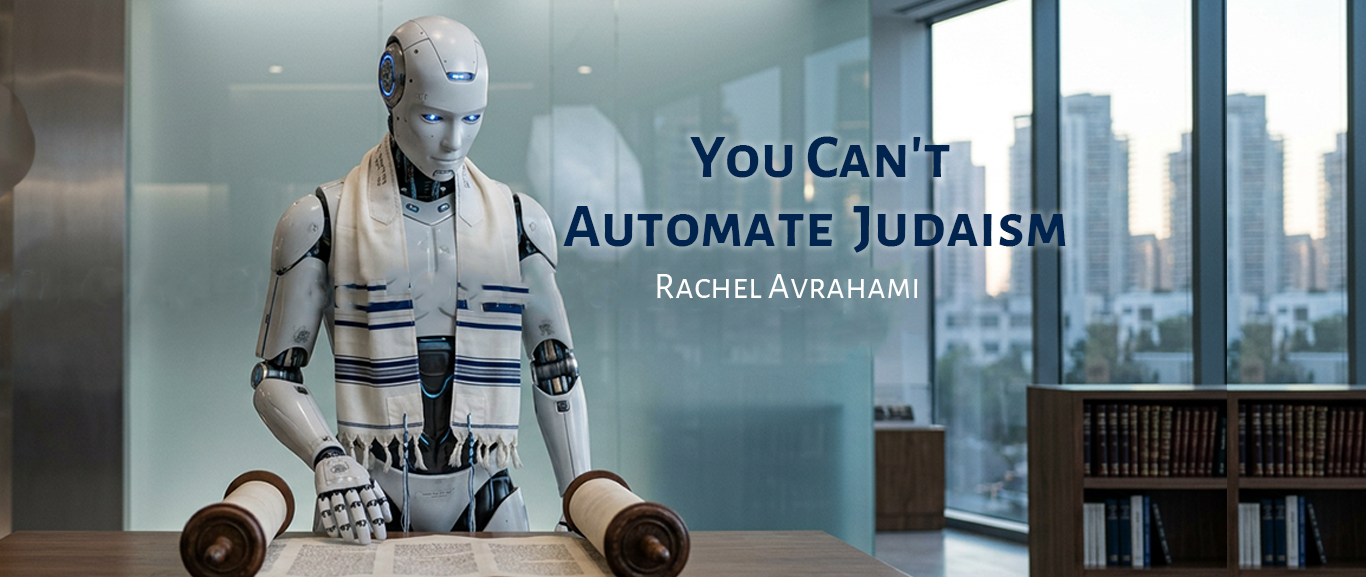
You Can’t Automate Judaism
Can Judaism be practiced on autopilot, or are we turning faith into a robotic routine? True service to God requires life and joy, not thoughtless habit. Here is a quick reminder of why intention matters and how to refresh your spiritual life.

David ben Horin wrote an article recently on AI and automation with regards to our lives which is quite an interesting perspective: (From Wheat to Wi-Fi: Finding Hashem in What We Build).
However, I want to add an important point to his article which is also very appropriate coming into Sukkot, and really the entire year. On Sukkot it is very important to be happy all the time, and our happiness on Sukkot is what infuses the rest of the Jewish year with happiness!
While David is correct that humans naturally make routines out of everything – which is actually important to our functioning – our relationship with Hashem and really all of Judaism should never, ever become routine!
This is seen most clearly with regards to prayer. The need for prayer to never become routine is exactly why personal prayer or hitbodedut every day is so important!
While prayer from the prayerbook is required every day, Rebbe Nachman stresses the importance of gathering every word of prayer like flowers being gathered into a bouquet, without losing or forgetting even a single one. This is called kavanah, or intention. Otherwise, Rabbi Arush says you’re basically just reading!
For those who think they can just get into the “routine” of praying with a minyan 3 times a day without concentrating on their prayers, or wishing they could just get on with their lives already… Rabbi Arush has a rude awakening. He says when they get to Heaven and are judged after their 120 years in this world, they won’t get any credit for praying in a minyan! They will simply get credit for reading from a book… if they even really did that…
The most personal and non-automated thing in the world is our personal connection to God Almighty in our hearts. A heart and soul connected to God Himself. Although we pray, and although we need to make sure we cover certain topics every day for our own good, nothing should ever become routine about our connection to Hashem!
Another example could be preparing for Shabbat. Many of us don’t have time to make new and different elaborate Shabbat feasts every week. Instead, we have a familiar routine of salads, fish, cholent, etc. that we can repeat quickly every week. However, even here our personal connection is critical – on every item, we are supposed to stop for one second and proclaim “L’kavod Shabbos kodesh!” “For the honor of Shabbat!” And G-d forbid I should just “routinely” light Shabbos candles and run off to something else… every week the prayers and the intentions and the feelings are different.
Rebbe Nachman specifically focuses on the need for “hitchadshut” – renewal. That our connection to Hashem, our prayers, and all the mitzvot that we do should not become rituals our routine that we “automate” or “perform.” Rather, they should be constantly renewed and infused with spirituality and intention!
Service of Hashem with routine and automation is about as dead as the machines that run AI… and service of Hashem is supposed to be ALIVE. God is called “the Living God.” Our connection to Him must also be alive, changing, growing, dealing with the ins and outs of our lives, our emotions and our struggles.
I remember speaking with my grandmother of blessed memory, who didn’t know anything about Torah or real Judaism. She once said to me, “I have no idea how you manage with all these rituals!” I replied, “Grandma, with all due respect – you manage with a bunch of rituals because whatever you do, you don’t understand what you’re doing or why. You do it because you were told this is Judaism. Me, I don’t perform any rituals! I know what I’m doing and why, and I love what I do because I love serving Hashem!”
Such “ritual Judaism” for lack of a better word very well might be like an automated AI program… but it’s a far cry from anything we’re supposed to be doing.
In fact, even if someone performs all the commandments perfectly, but without joy, love and connection – Hashem sends them curses! 98 curses in fact, terrible curses, Hashem should save us. “Because you did not serve the Lord your God with joyfulness and a good heart.”
Interestingly, the Hebrew there is “tuv l’vav.” It should say “tuv lev” – a good heart, generally translated in context as a happy heart. We find this same double-heart language in the Shema – “bchol levavcha.” The general commentary on this double-language is that you have to serve Hashem with both “hearts” – the left side of the heart which is the Evil Inclination, and the right side which is the Good Inclination.
I’m not about to start a Torah commentary here, but I would like to posit that this could refer to serving Hashem in a real manner. Even when it’s difficult, and when it’s routine, and maybe when we don’t quite feel like it – we have to try to connect to Hashem from a good place, with gratitude and appreciation.
There are also many stories of tzaddikim, righteous leaders, who personally performed routine tasks for a mitzvah. An example is Abraham who personally saddled the donkey to go to sacrifice Isaac at Hashem’s command instead of his servant Eliezer. There are many stories of tzaddikim personally preparing Shabbos or Chanukah candles, and many other such examples.
Hence, even if I could automate it, or have a robot do it, some things my own human hands must do on their own every single time! Although maybe having the robot clean up from all the cooking before Shabbos wouldn’t be so bad… 😂
Now is specifically the time to review our service of Hashem and see where we can put more “good heart,” love, and dedication and happiness into our routines.
To remember that Hashem “pays” for the happiness put into the mitzvah A MILLION TIMES more reward than for the mitzvah itself! Rabbi Arush says to take a moment before every mitzvah you do to awaken simcha shel mitzvah” in your heart – the happiness that you are about to do something eternal, in order to serve Hashem, and be happy about it! For instance, Rabbi Arush says that even if a man only put on tefillin once in his life, he should dance over just that one mitzvah for the rest of his life…
And especially, to make sure that we break the monotony and make time for the most important thing in all of Judaism according to Rebbe Nachman – an hour of personal prayer, speaking to God alone in your own words, every day!
***
Rachel Avrahami grew up in Los Angeles, CA, USA in a far off valley where she was one of only a handful of Jews in a public high school of thousands. She found Hashem in the urban jungle of university. Rachel was privileged to read one of the first copies of The Garden of Emuna in English, and the rest, as they say, is history. She made Aliyah and immediately began working at Breslev Israel.
Rachel is now the Editor of Breslev Israel’s English website. She welcomes questions and comments to her email: rachel.avrahami@breslev.co.il.






Tell us what you think!
Thank you for your comment!
It will be published after approval by the Editor.