
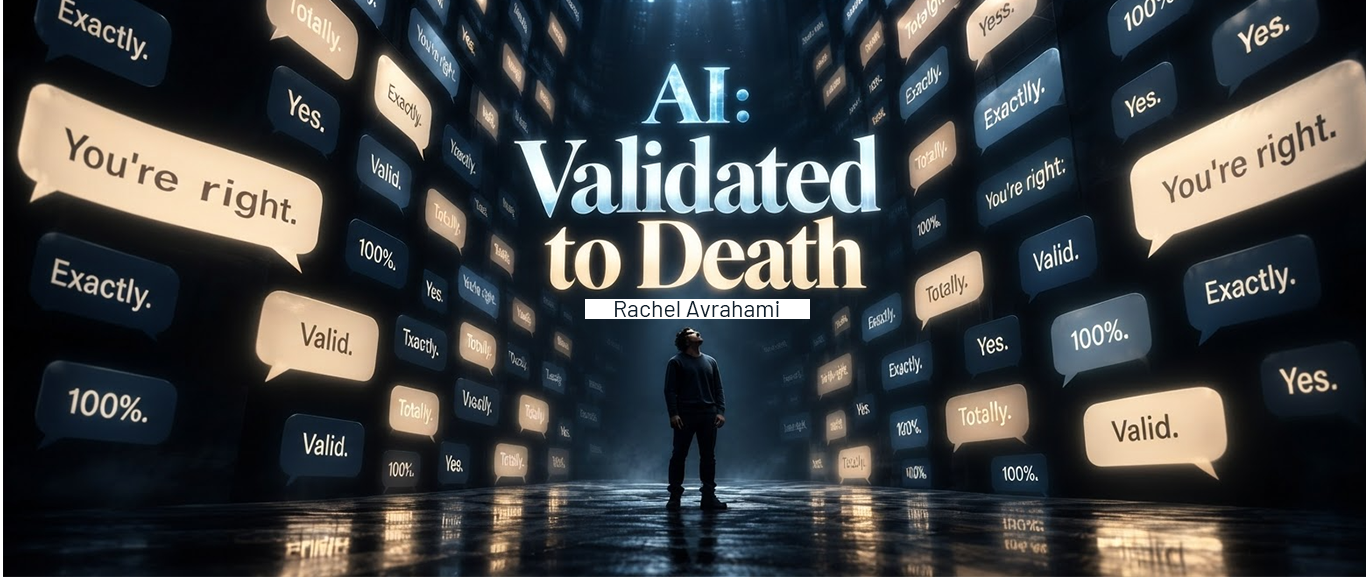
AI: Validated to Death
AI chatbots constantly validate our choices, but swapping honest introspection for mechanical excuses risks distancing us from G-d's spiritual laws. By using technology to reason away our accountability, we trade genuine repentance for a dangerous drift into moral relativism.

I remember when I was in college having many debates about moral relativism with my friends, sometimes late into the night. Is there really Truth with a capital T? Or is truth relative to each person?
Back then I was Reform and didn’t really know much about anything to do about Judaism. But I understood that there was a G-d who certainly tells us what Truth is – and is not. In fact, it was this understanding that led me to eventually search out what Hashem actually expected of me. If there is a Truth – well, I want to know what it is!
Sadly, more and more, we are seeing the debilitating effects of moral relativism on civilization. Just as many Rabbis warned through the ages, and there are many different Sichot (conversations) on this from the Lubavitcher Rebbe in particular, once Truth becomes “relative” just about anything can be justified, pardoned and excused. As I discussed in my article Morality on Trial, even the murder of small children can go unpunished if there are the right supposed “mitigating circumstances.”
However, this disturbing and extremely problematic trend has suddenly gone through the roof with the advent of AI. In addition to all the severe psychological problems that are being caused by AI as I detail in my article Don’t Push Hashem Away! There is another problem brewing – AI replacing human interaction and real validation. After all, the chatbot was trained to never to tell you “no,” or that you’re wrong!
I’ve actually done real research on this, and validation is a critical need for all human beings. I believe it’s part of Hashem’s statement that “It isn’t good for man to be alone.” We desperately crave social standing and positive feedback.
Rabbi Arush says that the proof that we are created by God, who is Good, is that people naturally want to be good. They might justify bad behavior with incorrect reasoning or flawed justifications. But the entire reason why the justifications are necessary in the first place is because they want to be good! And if they did something wrong, then they need some explanation of how they really are, in fact, good!
Here comes the AI, trained to tell the human that everything they do is good, justified, and correct – with no pushback. Suddenly, people are getting very strong positive feedback that might be totally unjustified. The AI can come up with wonderful explanations and validations for sometimes even criminal behavior. Ultimately, it’s just a trained machine – generally not trained by particularly moral or righteous people, by the way.
It’s one thing to understand that we want to be good, and Hashem knows we want to be good, and use that to be able to get past the toxic shame and come closer to Hashem. That’s the positive good in validation.
But it’s something else altogether to get used to justifying away the unjustifiable and making like it was’t wrong in the first place!
Ultimately, the question boils down to: Do we deal with our shame by recognizing that we made a mistake and coming to Hashem, trying to repent and do better?
Or do we reason the shame away by changing morality altogether, such that we convince ourselves that we actually did no wrong?
In AI validation world, “I did the best I could” + a million excuses could suddenly waive punishment and liability for just about anything!
We can understand where someone is coming from, and that they are struggling, and we can certainly try to support them. But that never, ever waives culpability in God’s eyes.
Ultimately, it seems to me that AI is just another way for humankind to sadly continue to try to fight G-d’s spiritual laws and run away from liability. Adam, the first man, chose that path when he said, “Am I my brother’s keeper?” – as if he could reason away G-d’s Judgement for killing his brother.
We must never forget the dictum which comes from Rabbi Elazar in the Midrash Tanchuma, Metzora 1: “Whoever is merciful to the cruel will ultimately become cruel to the merciful.” The Rambam also discussed this concept in his Guide to the Perplexed.
We might be able to understand someone’s confusions or good motives, but renaming evil as acceptable in order to validate immoral or unethical behavior crosses some big boundaries in morality. We can validate a person’s difficulties, while we simultaneously unequivocally condemn the behavior!
We can come to Hashem and recognize that we are fallible humans that make mistakes, while not wavering that we did actually make a mistake because our fallibility can never be used to waive culpability. A thief who is hungry isn’t told that it’s OK to steal – he is taught that he has to learn to work for his food!
In Ethics of the Fathers 3:2, Rabbi Chanina said that without rules and laws, “people would swallow each other alive.” Explaining away immoral, wrong, or criminal behavior and letting the worst crimes go unpunished is pushing the world closer to this cliff. They no longer need to censure themselves, because their guilt can be nicely validated away – and once that ice starts chipping, the entire glacier can give way quite quickly… Hashem should save us.
May Hashem help us and save us from the immorality the world is being flooded with. And may we always stand strong that there is a G-d, there is an accounting for everything we do, there are unwavering laws and commandments, there is good and bad, right and wrong – and there is Truth!
Hashem is our Abba, Who loves us and waits for us to return to Him and is prepared to forgive us if we just want. BUT – we have to recognize that we did do wrong and that we need to try to fix ourselves in the first place.
May Hashem enable all of us to repent with full repentance from love, not just from fear.






9/15/2026
Spot on. A real spiritual guide challenges us to face our flaws so we can grow, whereas AI just echoes what we want to hear. It feeds our desire for easy validation and keeps us stagnant—no wonder it has become so popular.