
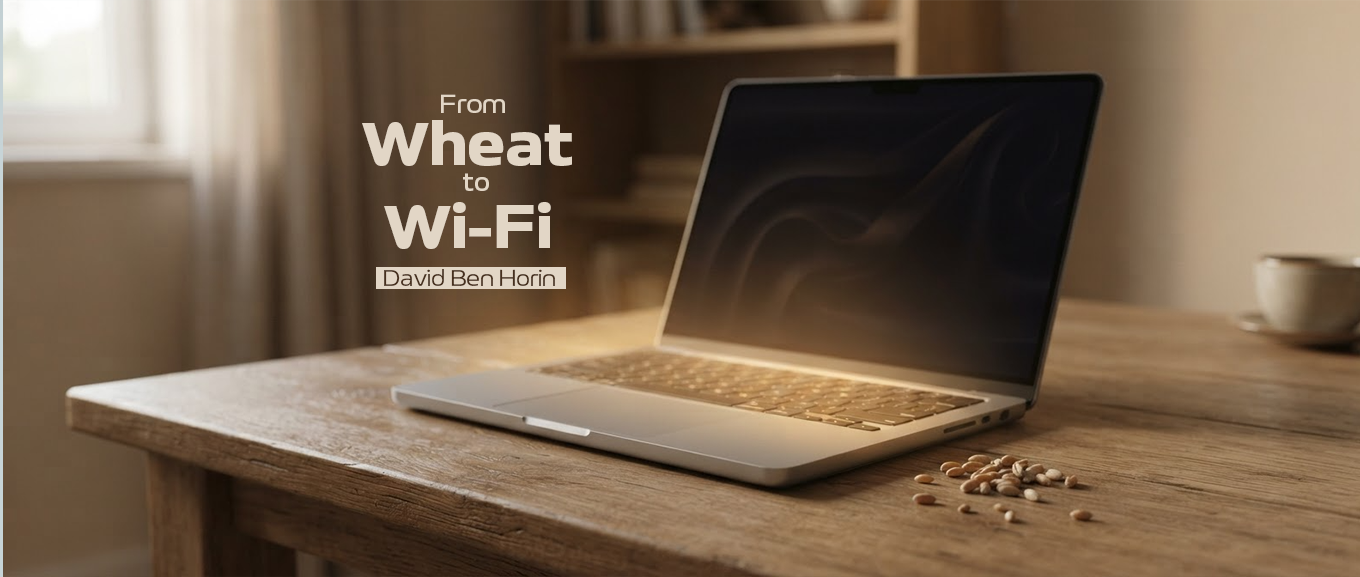
From Wheat to Wi-Fi: Finding Hashem in What We Build
Hashem is not waiting for us only in the synagogue, the siddur, or the fields of Eretz Yisrael. He can be discovered in the electrical current beneath our fingertips and the invisible waves passing through our homes. The great spiritual challenge of the technological age is seeing the ancient miracles hidden inside our newest machines.

The Apple Outside the Window
Imagine an apple tree standing somewhere in the Galil after a winter rain. Nobody plugged it in. Nobody programmed it. No engineer assembled its branches, installed its leaves, or instructed its roots to search through dark soil for water.
Hashem takes something smaller than the tip of your finger and writes an entire tree inside it.
The seed enters the earth. Rain falls. Sunlight pours down. Roots spread beneath the soil while branches reach toward the sky. Eventually, what began as something you could lose between your fingers can tower over a person and produce hundreds—even thousands—of apples in a year.
We stand underneath it and make one short berachah: Borei pri ha’etz.
Consider wheat. Hashem provides the astonishing beginning: seed, soil, rain, sunlight, and the mysterious biological machinery that turns a tiny grain into a stalk laden with new kernels. But then something changes: We enter the story.
When Man Enters the Field
Wheat does not jump out of the ground as a challah.
Someone has to harvest it. Someone has to separate the grain. The grain must be cleaned, stored, and ground. Flour must meet water. Dough must be mixed, kneaded, allowed to rise, and placed into an oven.
Bread contains something spiritually fascinating: human partnership is visible everywhere.
Over bread we encounter something extraordinary. After eating and being satisfied, the Torah itself commands us: “V’achalta v’savata u’veirachta”—you shall eat, you shall be satisfied, and you shall bless Hashem your God.
Birkat HaMazon takes us far beyond the sandwich we just ate. We thank Hashem for food, Eretz Yisrael and Yerushalayim. We ask for sustenance, mercy, and redemption. Our little piece of bread becomes a serious prayer of gratitude, supplication, and hope.
There is a lesson here. The more human fingerprints we see on something, the more urgently we need to search for the Divine fingerprints underneath them.
Now Look at Your Desk
Walk out of the wheat field and into an Israeli office tower in Tel Aviv, Jerusalem, or Haifa.
The wheat has disappeared. In its place are laptops, smartphones, fiber-optic connections, wireless routers, cloud servers and artificial intelligence. A programmer drinks coffee while writing code that will cross an ocean in milliseconds.
It can look like the exact opposite of the apple tree. The tree screams Creation. The computer screams engineering. But look again.
Your laptop is a wheat field.
Human beings did not create electricity. We learned to harness electrical phenomena built into Creation. We did not create electrons, atoms or the physical laws governing electrical charge.
We did not create light.
We discovered how to send enormous quantities of information through pulses of light racing through strands of glass.
We did not create the electromagnetic spectrum. Yet invisible electromagnetic waves can carry information between the smartphone in your hand and equipment kilometers away. You cannot see them, smell them, or grab them—and nevertheless your room is alive with them.
And the silicon at the heart of modern electronics?
Its raw material ultimately comes from one of the most ordinary substances on earth: silica, abundant in sand and rock.
Hashem scattered the ingredients across Creation. Then He gave human beings minds capable of discovering what they could become.
From Sand to Artificial Intelligence
Now take the idea one step further.
You open an artificial intelligence system and type a question. Seconds later, paragraphs appear. The machine can analyze language, generate images, write computer code, compare arguments, and recognize patterns across enormous amounts of information.
It feels breathtakingly new. But peel away the layers.
Behind artificial intelligence are data centers. Behind the data centers are computer chips. Behind the chips are semiconductor materials. What are these semiconductors actually conducting? The electricity God made in the seven days of creation.
And behind every equation, every engineering breakthrough and every line of code stands something even more astonishing: The human mind.
We did not manufacture the first human brain. We received it.
The engineer who designs the processor, the physicist who studies electricity, the mathematician who develops an algorithm, and the programmer who trains an artificial intelligence model are using intelligence they did not create to manipulate laws of nature they did not establish, using materials they did not bring into existence.
That does not diminish human accomplishment.
A farmer does not insult Hashem by turning wheat into bread. He fulfills the potential Hashem planted inside Creation.
The technologist does something similar when he turns sand into silicon, silicon into processors, and processors into machines capable of performing billions of calculations.
His challenge, and ours, is to remember where the wheat came from.
The Danger Begins with Forgetting
This is where technology becomes spiritually dangerous: When human achievement becomes so impressive that we can no longer see the Creator underneath it.
Moshe Rabbeinu warned us about precisely this spiritual reflex. A person becomes prosperous and successful and begins saying, “Kochi v’otzem yadi asah li et hachayil hazeh”—my strength and the power of my hand made this success for me.
That temptation becomes enormous in a technological civilization.
We split the atom. We crossed oceans. We landed machines on other worlds. We carry libraries in our pockets. We speak across continents. We teach machines to generate language.
Look what we built. . . then, look at what we built it with.
A Brachah Beside the Laptop
There is a simple exercise that can change the way you see your desk.
Tomorrow morning, place your coffee beside your computer. Before drinking, look at the machine.
Think about the electrical current moving through microscopic pathways inside it. Think about electromagnetic waves carrying information through the room. Think about light carrying data across fiber-optic networks, silicon inside processors, metals pulled from the earth, and petroleum transformed into plastics and insulation.
Then pick up the coffee.
The berachah is, of course, being made over the coffee—not the laptop. But allow the machine sitting beside it to deepen what you are about to say: Baruch Atah Hashem, Elokeinu Melech ha’olam, shehakol nihyeh bidvaro. Everything came into being through His word.
Everything.
The coffee.
The water.
The electricity.
The electron.
The electromagnetic wave.
The silicon.
The human brain.
The engineer.
The idea.
The ability to take the raw wheat fields of Creation and build something from them.
The Spiritual Task of the Technological Jew
Previous generations looked upward and saw a sky blazing with stars. They worked fields, waited anxiously for rain, and understood with painful clarity that their bread depended upon Heaven.
We live surrounded by switches.
Press here and light appears. Tap there and food arrives. Touch a piece of glass and speak to someone in New York. Ask a machine a question and an answer appears.
The miracle has not disappeared. We have buried it beneath convenience.
Our task is not necessarily to run from the machine. It is to peel it open spiritually. See the sand inside the microchip. See the sunlight inside the solar panel. See Creation inside the electrical socket.
See the Divine gift of human intelligence inside artificial intelligence.
And then build. Build companies. Build software. Build hospitals. Build farms. Build technologies that heal people, connect families, spread Torah, protect Israel, feed the hungry, and make this astonishing world more livable.
But never confuse the baker with the One Who made wheat possible.
The more magnificent our machines become, the more important it becomes to remember the ancient truth humming quietly beneath every one of them.
Hashem was never pushed out of the technological world.
We simply became so dazzled by what we built that we stopped noticing Who supplied the building blocks. Our task now is to look again.
***
David Ben Horin lives in Afula with his family, 60,000 passionate Israelis, and Matilda, our local camel.



9/15/2026
A pleasure, Tzvi. That was a wonderful comment.
9/15/2026
Thank you for your writing. I got here because the title was clipped off and presented as “From Wheat to Wi-Fi: Finding Hashem in What” on the earlier web page I was reading (likely because I use large fonts). I thought it might be a piece on “מה” and “מי”, “What” and “Who”. I’m glad I followed the link. I would like to make a comment based on my initial mistaken understanding of the title. Your article is a wonderful exploration of “מי” – as you say “noticing Who supplied the building blocks.” As someone who is immersed in technology I also pause and ask “who” as you do, but I also ask “What”. What are we? Yes, we are builders of the tech. Users of the building blocks. What we do with the technology can become so many layers of distraction! Unless, what we use for is to deeply connecting with others. Which is what you have done with your article. Thank you.